About 887 minutes
Thyrza — A Reader’s Guide
Historical Psychological Social Fiction
203,815 recorded words. 54 minutes difference from this book's estimate.
View Gutenberg source #4302
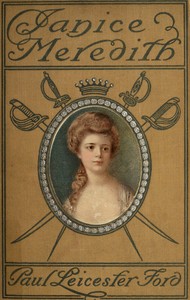
The source record for Janice Meredith: A Story of the American Revolution — Context and Discussion measures this digital text at 191,560 words, 13 hr 53 min estimated reading time, and 67 detected text sections.
The text analysis averages about 19.3 words per sentence, while the detected sections provide another way to judge how the source is divided.
Project Gutenberg metadata also associates the work with “United States -- History -- Revolution, 1775-1783 -- Fiction,” connecting these edition facts with the source record’s subject description.
Explore this collection
These alternatives are selected using recorded categories and estimated reading time.
About 887 minutes
Historical Psychological Social Fiction
203,815 recorded words. 54 minutes difference from this book's estimate.
View Gutenberg source #4302About 739 minutes
Historical Psychological Social Fiction
169,754 recorded words. 94 minutes difference from this book's estimate.
View Gutenberg source #4299About 714 minutes
Historical Psychological Social Fiction
164,043 recorded words. 119 minutes difference from this book's estimate.
View Gutenberg source #5773Search stored excerpts and compare books → Choose by your preferences →
Choices use stored catalog measurements. Estimates vary with reading speed. A shared category is a catalog label, not a claim that two books have the same argument or literary quality.
Search reads excerpt text stored with this catalog and links to its associated Gutenberg record. The connection is stored in the site database; this tool does not recheck that every excerpt is word-for-word identical to that external record. Excerpt search does not cover every chapter and does not verify historical publication dates.
Catalog snapshot checked: 2026-09-26. Coverage: 99 public books, 99 available source excerpts.
Calculated from edition completeness, EPUB availability, text structure and catalogue metadata. Not a user rating.
Total of 100 points, scaled to a 2.5-5.0 range. Editions with an empty description or a missing EPUB file are not scored.
Public-domain source text
The source text is kept in the dedicated reader, separate from this catalogue record and its commentary.
The excerpt from Paul Leicester Ford's Janice Meredith: A Story of the American Revolution opens with a tense family scene in which Janice is pressured into an arranged marriage with a British officer, Philemon. Her silent tears and dutiful compliance contrast sharply with her earlier rebelliousness, as noted by her father's expectation of a different reaction. The dialogue captures the period's formal speech patterns—'thou,' 'dadda,' 'mommy'—and the mother's sharp retort about Janice's 'misbehaviour' reveals a generational conflict over obedience.
Later, a sudden intrusion by a cloaked man named Brereton in the kitchen introduces an element of stealth and secrecy. The narrative notes that his touch is both firm and caressing, suggesting a prior relationship. This juxtaposition of public duty and private emotion, set against the backdrop of British occupation, establishes a pattern of personal dilemmas intersecting with revolutionary politics.
The excerpt centers on a forced betrothal, where Janice's father, Squire Meredith, expects a kiss to seal her obedience. Instead, she bursts into tears, a 'contrary behaviour' that disarms him. Her mother, Mrs. Meredith, invokes her own past disobedience—'a giddy, perverse child I was'—to justify her insistence on Janice's compliance. This mirroring of mother and daughter highlights a cycle of rebellion and regret. Janice's final assent, 'I'll do as you and mommy tell me,' is delivered through sobs, undercutting any sense of resolution. The scene uses precise gestures—a kiss, a hug, tears—to dramatize the power struggle within a colonial household.
The dialogue is rich with period-appropriate language: 'bespeaks ye,' 'hearn,' 'anent,' and 'I' faith.' These terms ground the story in the 18th century without becoming archaic. Social rituals are emphasized, such as the ladies rising to leave after a glass of punch, and the mention of 'casing of colours and muffling of drums' for a funeral. Sir Frederick Mobray's jest about Janice's gloom being mistaken for a funeral underscores the tension between public cheer and private sorrow. The characters' speech reveals their social positions: Philemon's eagerness to announce his success to his regiment contrasts with Janice's silence, which his fellow officers notice and mock.
The kitchen encounter with Brereton is a sudden shift from domestic pressure to clandestine romance. Janice is intercepted by a maid, then startled by a man 'from behind the chimney breast.' His hand on her lips prevents a scream, yet the narrative notes 'an element of caress in their touch.' Brereton's words—'I seem doomed to fright you, Miss Meredith'—imply a history of such meetings. This scene introduces a pattern of stealth and hidden communication, set against the larger backdrop of espionage and military movements. The chapter titles in the table of contents, such as 'Spies and Counter-Spies' and 'A Cartel of Exchange,' suggest that such covert interactions will recur throughout the novel.
Readers should attend to how Ford uses domestic settings—kitchens, parlors, wedding plans—as stages for larger political conflicts. The tension between Janice's private feelings and public expectations mirrors the colonial struggle between loyalty and rebellion. The excerpt's focus on a single, emotionally charged scene offers a microcosm of the novel's method: personal relationships are never merely personal, but are entangled with the war's demands.
That gray afternoon, Janice Meredith left me tangled in old questions—how much do we owe our parents, our duty, our own restless hearts? The rain kept company with her quiet rebellion. Later, idly, I found Married Life; Its Shadows and Sunshine — Key Ideas to Explore, and something eased. Another century, same shadows. I simply sat with both, letting the damp light settle.
Answer a few questions and save a private reflection on this device.