About 301 minutes
After the Storm — Text and Context
Historical Psychological Social Fiction
69,063 recorded words. 12 minutes difference from this book's estimate.
View Gutenberg source #4590
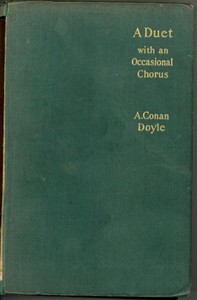
This digital edition of A Duet, with an Occasional Chorus — Reading Companion is described by source-level measurements including 71,986 words, 5 hr 13 min estimated reading time, and 8 detected text sections.
The text analysis averages about 12.9 words per sentence, while the detected sections provide another way to judge how the source is divided.
Project Gutenberg metadata also associates the work with “Married people -- Fiction,” connecting these edition facts with the source record’s subject description.
Explore this collection
These alternatives are selected using recorded categories and estimated reading time.
About 301 minutes
Historical Psychological Social Fiction
69,063 recorded words. 12 minutes difference from this book's estimate.
View Gutenberg source #4590About 298 minutes
Historical Psychological Social Fiction
68,500 recorded words. 15 minutes difference from this book's estimate.
View Gutenberg source #4308About 293 minutes
Historical Psychological Social Fiction
67,270 recorded words. 20 minutes difference from this book's estimate.
View Gutenberg source #5435Search stored excerpts and compare books → Choose by your preferences →
Choices use stored catalog measurements. Estimates vary with reading speed. A shared category is a catalog label, not a claim that two books have the same argument or literary quality.
Search reads excerpt text stored with this catalog and links to its associated Gutenberg record. The connection is stored in the site database; this tool does not recheck that every excerpt is word-for-word identical to that external record. Excerpt search does not cover every chapter and does not verify historical publication dates.
Catalog snapshot checked: 2026-09-26. Coverage: 99 public books, 99 available source excerpts.
Calculated from edition completeness, EPUB availability, text structure and catalogue metadata. Not a user rating.
Total of 100 points, scaled to a 2.5-5.0 range. Editions with an empty description or a missing EPUB file are not scored.
Public-domain source text
The source text is kept in the dedicated reader, separate from this catalogue record and its commentary.
Arthur Conan Doyle's A Duet, with an Occasional Chorus (1899) opens not with a crime but with a courtship by letter. The first chapter, 'The Overture,' consists entirely of correspondence between Frank and Maude as they negotiate their wedding date—a mundane negotiation that reveals character through small hesitations and second thoughts. Frank proposes August 3rd, then worries about Bank Holiday travel; Maude agrees but notes dressmakers and guests. The novel's catalog subject is 'Married people -- Fiction,' and the excerpts bear this out: the story stays close to the couple's domestic sphere, from tea at a City hostel to the purchase of suede gloves. Yet the title promises occasional interruption—a 'chorus'—and the dedication to Mrs. Maude Crosse frames the book as a 'private log' for other 'two-oared boats' navigating marriage.
The early chapters rely almost entirely on epistolary exchange. Frank's letters show a man who revises plans impulsively—first suggesting August 3rd, then worrying about Bank Holiday crowds, then pushing the date earlier. Maude's replies are accommodating but practical, noting guests and dressmakers. The excerpts give no indication of major conflict; instead, the tension is in small adjustments. Doyle uses the letter form to reveal personality through rhythm and concern: Frank's anxiety about Uncle Joseph's travel comfort, Maude's willingness to please. The 'rest is irrelevant' asides suggest the author is selectively presenting only the negotiation, not the full correspondence. This technique gives the reader a sense of eavesdropping on a private deliberation, with the couple's voices distinct even in brief fragments.
A later excerpt shifts to a rendezvous in London. Maude deciphers a cryptic telegram from Frank—'Pepys—buttered toast—suède gloves—four—Monument, wait late'—by reasoning through each element. The passage is notable for its detailed attention to Maude's mental process: she connects 'suède gloves' to a specific shop where she can save sixpence, and 'buttered toast' to a City hostel. Doyle then describes the couple's meeting at the Monument, their underground train ride, and their shared delight in 'abominable surroundings.' The description of the 'mephitic cellar' and 'strangling gas' is vivid, but the couple's happiness overrides the gloom. This section shows Doyle's interest in the texture of urban life—train schedules, shopping economies, and the romance of ordinary places. The dialogue is light and teasing, with Frank complimenting Maude's 'brown' dress and she correcting him: 'Fawn colour.'
The dedication to Mrs. Maude Crosse explicitly compares marriage to a 'two-oared boat' navigating a 'great ocean' with 'rocks and sandbanks.' Doyle writes that he offers 'a few pages of your own private log' to help other couples. This metaphor shapes the novel's structure: the chapters are titled as musical movements ('Overture,' 'Solo,' 'Duet'), and the dedication promises both 'days of peace' and 'days of storm.' The excerpts show only the peaceful outset—letter-writing and a cheerful outing—but the dedication hints at later difficulties. The catalog subject 'Married people -- Fiction' is accurate, but the dedication adds a layer: the book is presented as a practical guide, a 'chart' for navigation. Whether the storms that follow are serious or 'petty' (as the dedication suggests) is not clear from the excerpts, but the framing gives the domestic details a didactic purpose.
The excerpts from A Duet, with an Occasional Chorus reveal a novel that dwells in the small negotiations and shared pleasures of early marriage, rendered with specific period detail—Bank Holiday travel, City hostelries, the cost of gloves. Doyle's prose is observant and occasionally wry, but the tone remains affectionate. Readers should expect a leisurely, episodic narrative that prioritizes character interaction over plot, and a work that, despite its author's fame, is closer to domestic comedy than to mystery or adventure.
Years among the stacks teach you how certain books breathe together. In A Duet, Doyle’s quiet joy in shared domestic rhythms lingers long after the page. That same gentle intimacy, the subtle texture of everyday life among women of a certain world, seems to echo in The Rich Mrs. Burgoyne — Key Ideas to Explore. Both feel less like stories and more like remembered mornings, sunlight on a familiar chair.
Answer a few questions and save a private reflection on this device.